

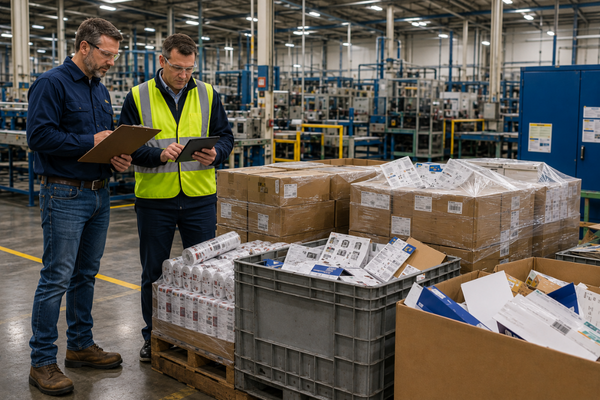
The Challenge: Choosing the Right Path for Nonconforming Materials
Rejected, obsolete, damaged, or noncompliant materials can sit in a facility longer than they should because no one is fully sure how they should leave the building. For many Massachusetts businesses, the decision comes down to off-spec material destruction vs disposal. Disposal may be enough for low-risk material. Recycling may make sense when the material can be separated and recovered. Destruction is usually the right path when the material carries brand, confidentiality, documentation, or product-risk concerns.
The question is not only whether the material has value. It is whether the material could create a problem if it leaves your control intact.
What Counts as Off-Spec Material?
Off-spec material is any product, package, component, printed item, prototype, or inventory lot that no longer meets internal requirements, customer specifications, regulatory expectations, or brand standards. In a manufacturing plant, that may include mislabeled packaging, defective parts, failed production runs, obsolete labels, returned goods, or discontinued branded materials. In a warehouse or municipal operation, it may include damaged inventory, outdated supplies, unusable equipment, or confidential materials from a cleanout.
Some off-spec material is simply waste. Some still has recoverable commodity value. Some should be destroyed before it goes anywhere else. The difference depends on the risk tied to the material, not just the material itself.
Off-Spec Material Destruction vs Disposal: The Core Difference
The practical difference between destruction and disposal is control.
Disposal generally means the material is removed from the facility as waste. It may go into a container, transfer stream, landfill, or other approved disposal pathway. That may be appropriate for non-sensitive material with no reuse value, no confidential content, no product liability concern, and no brand exposure.
Destruction means the material is intentionally made unusable, unreadable, unrecoverable, or unfit for resale before final recycling or disposal. Depending on the material, that may involve shredding, crushing, dismantling, separation, or another handling method. For businesses comparing off-spec material destruction vs disposal, destruction is usually the better fit when removal alone does not solve the problem.
For facilities with confidential data, prototypes, branded packaging, or restricted inventory, our Data & Product Destruction service provides a controlled path for materials that need more than standard disposal.
When Standard Disposal May Be Appropriate
Standard disposal may be appropriate when the material is low sensitivity and has limited recovery value. Examples may include damaged non-branded goods, contaminated packaging that cannot be recycled, broken non-confidential items, or general facility waste from a cleanout.
Before choosing disposal, facility managers should ask a few direct questions. Does the material include customer, employee, financial, or proprietary information? Does it carry a recognizable brand, logo, product name, or labeling system? Could it be mistaken for usable inventory? Would it create a problem if it appeared in a resale channel, online marketplace, unauthorized donation stream, or public waste area?
If the answer is no, disposal may be sufficient. If the answer is yes or uncertain, standard disposal may leave too much exposure.
When Recycling Is the Better Option
Recycling should be considered when off-spec material still has recoverable value and does not need secure destruction first. Clean corrugated cardboard, certain plastics, metal, paper, and other commodity materials may be suitable for recycling if they can be separated, stored, and transported properly.
Recycling is not a substitute for destruction when intact material creates brand exposure, confidentiality concerns, product misuse risk, or unauthorized resale risk. In those cases, destruction should be evaluated before the material enters a recycling stream.
The complication is that off-spec materials are often mixed. A pallet of obsolete inventory may include cardboard, plastic film, printed labels, metal components, and confidential documents. Some items may be recyclable. Others may need destruction. Treating the whole load as trash can increase disposal costs and waste recoverable material. Treating the whole load as recyclable can create risk if sensitive items remain intact.
A better approach is to separate material by risk and recovery path. Our commercial recycling team helps businesses evaluate recyclable streams, equipment needs, pickup schedules, and material value. For facilities generating recurring recyclable volumes, this can make the process cleaner and easier to manage.
When Certified Material Destruction Is Necessary
Certified material destruction is appropriate when the business needs a record showing that the material was destroyed. This is common for confidential records, data-bearing devices, branded goods, prototypes, restricted packaging, defective products, and obsolete inventory that should not return to the market.
Documentation matters because internal teams may need a record for quality, insurance, customer, audit, or compliance purposes. A certificate of destruction can help show that the material was handled through a controlled process rather than discarded as ordinary waste. Documentation needs vary by material type, customer requirements, internal policy, and any applicable contractual obligations, so facilities should confirm what recordkeeping is required before scheduling removal.
This is especially important for secure disposal for off-spec materials that include product designs, private information, or proprietary components. A manufacturer may need to protect a prototype. A distributor may need to remove mislabeled branded packaging. A healthcare-related operation may need to manage obsolete media or records. A municipal or institutional facility may need to show that sensitive items were removed from service and destroyed.
For confidential material streams, confidential material disposal services support businesses that need more than ordinary waste removal.
Brand Exposure and Product Confidentiality
Brand exposure is one of the clearest reasons to choose destruction over disposal. Branded materials can create problems even when the product itself has no market value. Printed cartons, labels, uniforms, product samples, point-of-sale materials, packaging inserts, and defective branded goods can be misused if they leave the facility intact.
Product confidentiality is another concern. Off-spec prototypes, test units, sample packaging, and experimental parts can reveal design information, customer information, supplier details, or production changes. For manufacturers, designers, and distributors, destruction is often less about waste handling and more about protecting business information.
This is where material destruction services Massachusetts businesses can access locally are useful. Local coordination can reduce handoffs, simplify scheduling, and help facilities maintain control over staging, loading, documentation, and final handling.
Massachusetts Operations Need Practical Material Control
Massachusetts facilities often manage off-spec material under space, timing, and transportation constraints. Warehouses, manufacturing plants, municipal departments, and institutions may not have room to hold obsolete inventory for long, but moving it too quickly without the right disposition path can create avoidable exposure.
A local handling plan can help align staging, equipment, pickup timing, documentation, and downstream processing. For recurring industrial or institutional material streams across Massachusetts and Southern New England, that coordination can make the difference between a clean removal process and a recurring operational problem.
A Practical Decision Framework for Massachusetts Facilities
The best way to evaluate off-spec material is to assign it to a disposition path before it leaves the building.
Start with sensitivity. If the material contains data, confidential information, proprietary design details, or branded content, review destruction first. Next, look at reuse risk. If someone could resell, donate, counterfeit, misrepresent, or mistakenly use the material, standard disposal may not be enough.
Then assess recyclability. If the material can be safely separated into paper, cardboard, plastic, metal, electronics, or other recoverable streams, recycling may reduce disposal volume and preserve commodity value. If recyclable material must be destroyed first, the process should be planned so destruction and downstream recycling work together.
Finally, determine documentation needs. If a customer, quality manager, insurer, auditor, or internal team may ask what happened to the material, certified material destruction is often the safer choice.
Can Off-Spec Materials Be Destroyed and Recycled?
Yes. Many off-spec materials can be destroyed and then recycled, depending on material type, condition, and contamination level. Paper, cardboard, some plastics, metal, electronics, and media components may be destroyed, separated, and directed toward appropriate recycling streams when feasible.
The sequence matters. Sensitive material should not be sent into a recycling stream intact if it creates brand, confidentiality, or product risk. Destruction may come first, with recycling or disposal as the final downstream path.
Applied Example: Obsolete Branded Packaging
Consider a Massachusetts manufacturer with several pallets of obsolete branded packaging after a product redesign. The cartons are clean and made from recyclable paperboard, but they include product names, logos, barcodes, and outdated claims.
Standard disposal would remove the pallets, but it would not fully address brand exposure. Recycling may recover fiber value, but intact packaging could create risk before processing. In this case, the better path may be documented destruction followed by recycling where possible. A destruction record or certificate can help the facility show that the obsolete packaging was handled through a controlled process. The facility clears obsolete inventory, protects the brand, and avoids sending recoverable material into the general waste stream when practical.
For more detail on this type of situation, read more on how to handle off-spec packaging materials without creating compliance or brand risk.
Building a Repeatable Process
One-time obsolete inventory disposal can usually be managed as a project. Recurring off-spec material needs a process. Facilities should identify who approves destruction, where material is staged, how it is labeled, what documentation is required, and which vendor is authorized to remove it.
This matters for warehouses, manufacturers, institutions, and municipal operations with multiple departments generating different material streams. A repeatable process reduces confusion and helps prevent off-spec items from being placed in the wrong container.
Choosing the Right Local Partner
Businesses comparing off-spec material destruction vs disposal need more than a pickup. They need help evaluating the material, identifying the right disposition path, coordinating transportation, and supporting documentation where required.
At Miller Recycling, we work with commercial, industrial, municipal, and institutional accounts throughout Massachusetts and Southern New England. We help facilities determine when disposal is sufficient, when recycling is practical, and when certified material destruction is the appropriate route.
If your business is evaluating obsolete inventory disposal, secure disposal for off-spec materials, or commercial waste handling Massachusetts operations need for nonconforming material, contact us to discuss your material, risk level, timeline, and documentation needs.