

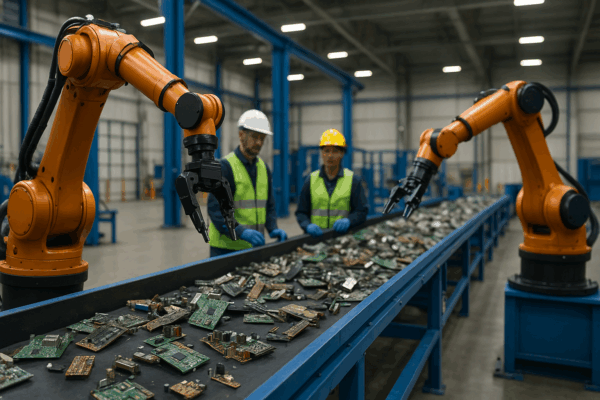
From outdated servers and spent lithium batteries to broken monitors and obsolete circuit boards, electronic waste is piling up fast—and so are the challenges for Massachusetts facilities trying to manage it responsibly. As pressure mounts from environmental regulations, material shortages, and ESG goals, forward-thinking organizations are looking beyond traditional disposal methods. Today’s e-waste recycling innovations are unlocking smarter, safer, and more efficient ways to recover valuable resources and reduce environmental impact. Understanding these technologies is essential for any facility or municipality aiming to future-proof its operations and stay ahead of compliance demands.
Why e‑waste recycling innovations matter
The UN’s Global E‑Waste Monitor reports that over 62 million tonnes of e‑waste were generated in 2022, growing rapidly and outpacing recycling rates by a factor of five. Industry experts also note that less than 1 % of rare earth elements are being recovered from e‑waste today. These trends reinforce why businesses and municipalities need to pursue e‑waste recycling innovations that increase material recovery while reducing environmental harms.
Cutting‑edge Technologies Transforming E‑Waste Recycling
To meet these challenges head-on, a range of cutting-edge technologies is emerging that redefines what’s possible in e-waste recycling—boosting recovery rates, improving safety, and supporting regulatory compliance. Here are some examples.
1. AI‑Powered Sorting & Vision Systems
In a recent industry first, Recycleye and SWEEEP Kuusakoski successfully implemented an AI-powered sorting system to detect and sort waste electrical and electronic equipment (WEEE) using visual identification rather than traditional sensors. The system can distinguish circuit boards, batteries, and plastics with high accuracy, improving recovery rates and reducing contamination. By identifying lithium-ion batteries and other hazardous components during the sorting process, this technology also enhances safety in recycling facilities
2. Robotic Disassembly & Hazardous Material Handling
Robots in projects like Fraunhofer IFF’s iDEAR system are automating the unscrewing and dismantling of electronics—from flat‑panel displays to servers—removing fasteners and separating hazardous components like batteries and circuit boards with minimal human intervention. This automation not only speeds up throughput but also enhances safety and reduces labor needs in e-waste processing facilities.
3. Bioleaching & Biorecovery
Researchers are using specialized bacteria—such as Acidithiobacillus ferrooxidans and Chromobacterium violaceum—to extract metals like copper, nickel, and gold from circuit boards and batteries. These bioleaching methods can achieve recovery rates above 90% for certain metals, offering a low-energy, non-toxic alternative to traditional chemical processing.
4. Chemical Recycling: Hydrometallurgy & Novel Polymers
Hydrometallurgical approaches—including the use of thiosulfate and sulfur-based polymers—are enabling near‑99 % purity recovery of precious metals like copper and gold from e-waste without cyanide. These greener chemical pathways offer energy-efficient alternatives while maintaining high extraction yields and reduced toxicity.
(Note: Specific new sources confirming 99% recovery with sulfur polymers may be forthcoming; current evidence supports safe, high‑purity extraction via thiosulfate systems.)
5. Rare Earth Element Recovery Breakthroughs
At ETH Zürich, chemists have devised a novel extractant that enables precise separation of rare earth elements (such as europium) from fluorescent lamp waste. This nature-inspired solvent enables recovery of REEs currently recycled at rates below 1%, offering scalable solutions to supply critical materials sustainably Reuters+1.
6. Smart IoT & CNN Classification Systems
Recent research proposes integrating IoT sensors (e.g., imaging and digital weight scales) with lightweight convolutional neural networks to perform real-time classification of e-waste components—like circuit boards, wires, sensors—automating routing decisions and improving sorting accuracy in recycling workflows.
7. Microfactories & Localized Processing
UNSW’s SMaRT Lab pioneered scalable, facility‑based “microfactories” that apply modular thermal and material processing to reclaim plastics, metals, and rare materials from e-waste onsite—such as transforming discarded electronics into 3D-printing filaments or new components. This small-footprint approach enables local institutions to close material loops and reduce reliance on centralized recycling plants.
What These Innovations Mean for MA Facilities & Municipalities
The benefits of adopting e‑waste recycling innovations are substantial:
- Increased recovery rates: advanced sorting and hydrometallurgy deliver higher yields of copper, gold, silver, and rare earths.
- Environmental protection: greener biotechnologies and safer chemical methods reduce toxic exposures.
- Compliance & leadership: pioneering facilities position themselves ahead of evolving regulations and circular economy expectations.
- Reduced operational costs: automation and smart systems lower manual labor and contamination risk.
In Conclusion
The rapid pace of e-waste recycling innovations is reshaping how electronics are managed—from robotic disassembly and AI sorting to bio-based metal recovery and rare-earth extraction. While not all of these technologies are yet widely adopted, they signal where the industry is heading—and they offer a roadmap for facilities and municipalities looking to stay ahead of regulatory and sustainability demands.
At WM Mansfield Recycling, we’re closely tracking these advancements to ensure our services evolve with the needs of Massachusetts institutions. Whether you’re refining an existing recycling program or planning for future improvements, our team can help you align with best practices, recover more value, and meet your environmental goals. Contact us to learn how our electronics recycling and compliance services can support your operation.