

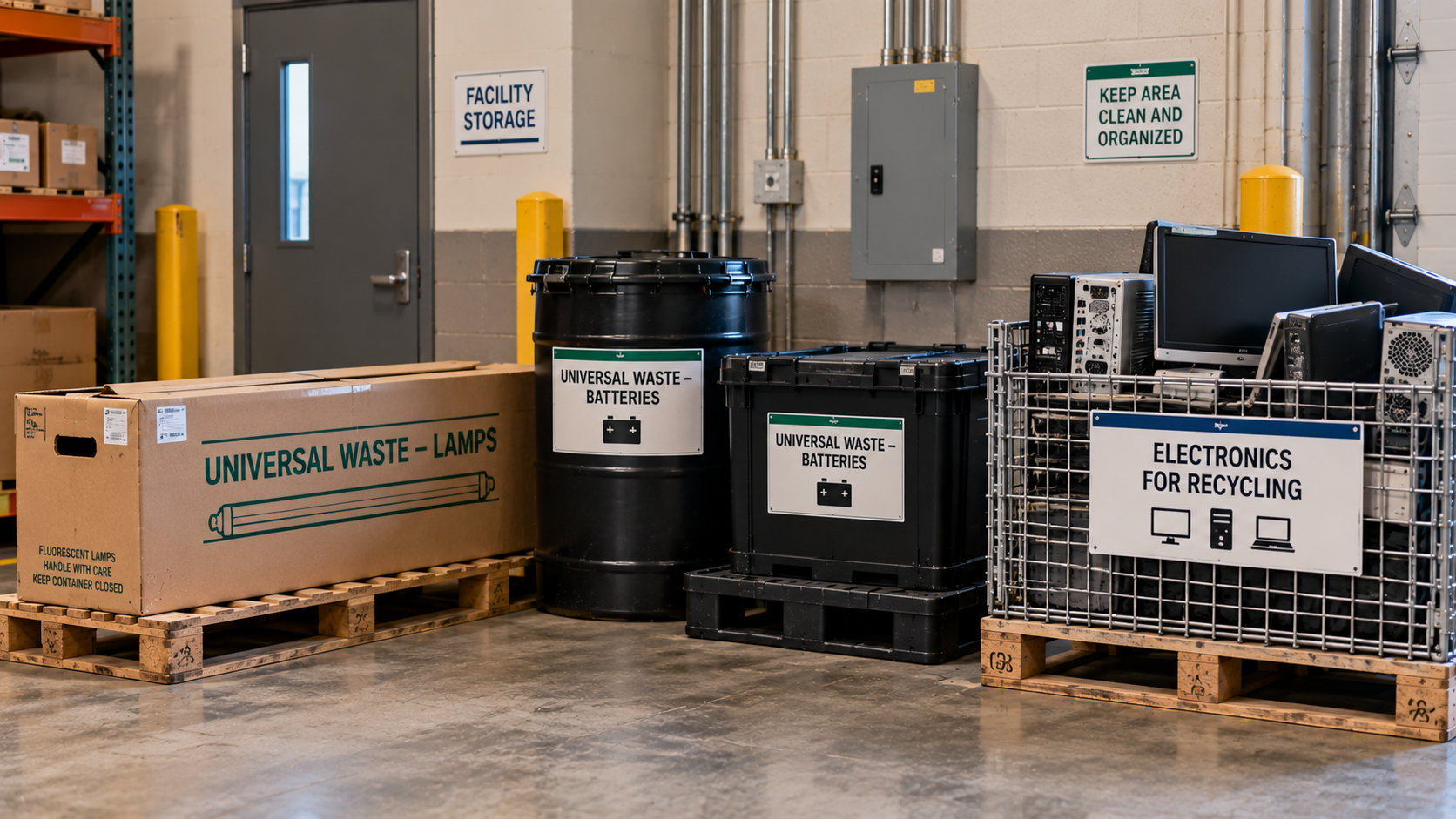
For facility managers and EHS teams, universal waste rules for batteries, lights and e waste affect routine work across several departments. Maintenance replaces fluorescent tubes. IT retires computers and monitors. Operations staff collect spent batteries from equipment. In a school district, hospital, municipal department, warehouse, or manufacturing plant, these materials can accumulate in several places before anyone schedules a pickup.
A workable program needs to answer a few basic questions: What is the material? Where should employees put it? How should it be labeled and stored? How long has it been there? And where does it go next?
Getting those details right reduces the chance that regulated material ends up in the wrong waste stream.
Understanding Massachusetts Universal Waste Regulations
Massachusetts regulates universal waste under 310 CMR 30.1000. The rule covers batteries, pesticides, thermostats, mercury-containing devices, mercury-containing lamps, and aerosol cans when they meet the applicable regulatory criteria. Not every battery or lamp is hazardous waste and therefore not every one qualifies as universal waste. The Massachusetts hazardous waste regulations provide the underlying requirements.
Electronic waste needs to be considered separately. Computers, monitors, printers, servers, and similar electronics are often collected alongside lamps and batteries, but Massachusetts does not classify all e-waste as universal waste. Cathode ray tubes, or CRTs, are also specifically included in the state’s waste disposal bans.
For facility teams, that distinction matters. Batteries, lamps, and electronics can be managed through a coordinated recycling program, but they should not automatically be assigned the same regulatory classification.
Universal Waste Rules for Batteries, Lights and E Waste Start at the Collection Point
Problems often begin long before material reaches the loading dock.
A hospital may generate batteries in clinical and maintenance areas, lamps throughout the building, and electronics through IT. A school district may have the same materials spread across classrooms, offices, maintenance shops, and technology departments. A municipal operation may collect them from several buildings.
If every department handles these materials differently, the central storage area eventually inherits the problem.
Set up designated collection points and give employees clear instructions about what belongs in each container. Keep batteries, mercury-containing lamps, electronics, and ordinary solid waste separate.
Collection areas also need to fit the work being done around them. A lamp box placed where carts or forklifts can strike it is not a good storage location, even if the box itself is properly labeled.
For facilities reviewing more than one waste stream, our recycling materials overview covers the range of materials we help businesses manage.
Label Universal Waste as Soon as It Begins Accumulating
Massachusetts specifies labeling options for universal waste. Universal waste batteries, for example, may be marked “Universal Waste – Battery(ies),” “Waste Battery(ies),” or “Used Battery(ies).” Mercury-containing lamps have corresponding approved labeling options under 310 CMR 30.1034.
Employees should not have to open a container or ask a supervisor to determine what is inside.
Facilities also need to be able to demonstrate how long universal waste has accumulated. Massachusetts generally allows universal waste to be accumulated for no longer than one year from the date it becomes waste or is received from another handler, subject to a limited exception for accumulating quantities needed to facilitate proper recovery, treatment, or disposal.
The regulations allow several methods for documenting accumulation time. One straightforward option is marking the container with the earliest date any universal waste in it became waste or was received. Facilities may also use an onsite inventory system or other methods specified in the rule.
Whichever method is used, make it part of routine EHS or facility inspections rather than waiting until a pickup is due.
Follow Battery Recycling Rules Based on the Battery Type
A single container marked “batteries” may hold several different chemistries. That can create handling and transportation problems.
Lithium-ion, nickel-cadmium, button, lead-acid, and other batteries do not necessarily have identical regulatory or shipping requirements. Facilities should identify the battery types they generate before setting collection and shipping procedures. Our Battery Recycling: What You Need to Know article provides additional background on common battery types and recycling considerations.
Massachusetts universal waste regulations require batteries to be managed in a way that prevents releases. A battery showing evidence of leakage, spillage, or damage that could cause leakage must be placed in a closed, structurally sound container compatible with the battery.
Terminal protection should be addressed separately as part of safe battery handling and transportation. Depending on battery chemistry and applicable transportation requirements, facilities may need to protect terminals from contact and short circuits. That is not the same requirement as Massachusetts universal waste labeling or accumulation rules.
Damaged batteries also need a separate procedure. A swollen, leaking, punctured, or otherwise damaged lithium-ion battery should not simply be dropped into a routine collection container.
For facilities that generate batteries regularly, written procedures should identify accepted battery types, approved containers, terminal-protection practices, damaged-battery procedures, and responsibility for moving material to the central collection area.
Protect Fluorescent and Mercury-Containing Lamps From Breakage
Massachusetts requires mercury-containing lamps managed as universal waste to be placed in a container or package that is structurally sound, compatible with the lamps, and adequate to prevent breakage. Those containers and packages must remain closed and be maintained to prevent leakage, spillage, or damage that could cause a release.
That makes storage location important. Keep lamp containers away from forklifts, carts, pallet movement, and other activities that can damage them. Loose tubes leaning against a wall or stacked in a maintenance room are difficult to protect from breakage.
Broken lamps require prompt attention. Massachusetts requires handlers to immediately clean up broken mercury-containing lamps and place them in an appropriate closed container. Employees responsible for these materials should know the facility’s handling and emergency procedures.
For schools, hospitals, municipal buildings, and large facilities, those instructions should be available to the employees most likely to encounter a broken lamp—not just the person who manages waste contracts.
Track the 5,000-Kilogram Universal Waste Threshold
Massachusetts defines a Small Quantity Handler of Universal Waste as a handler that accumulates less than 5,000 kilograms of total universal waste at any time. Reaching 5,000 kilograms moves the facility into the Large Quantity Handler category, which carries additional requirements.
Large Quantity Handlers have requirements that include notification and shipment tracking. The accumulation-time requirements still need to be managed regardless of handler category. Even facilities well below the threshold should track two things: how much universal waste is onsite and how long it has been accumulating.
That does not require a complicated system. Container dates, inventory records, scheduled inspections, pickup records, and a list of active storage areas can provide practical control.
Why E-Waste Needs a Separate Management Process
Facilities often collect electronics alongside batteries and lamps, which can lead to the assumption that all three are universal waste. They are not.
Retired computers, monitors, servers, printers, laboratory equipment, and other electronics should have their own collection procedure. CRTs are among the materials Massachusetts bans from disposal or transfer for disposal. Lead-acid batteries are also included in the state’s disposal bans.
For a closer look at the state requirements that affect older equipment, see our guide to disposing of older electronics according to Massachusetts electronics recycling rules.
Data-bearing equipment adds another requirement. Massachusetts standards for disposal of personal information require electronic and other non-paper media containing personal information to be destroyed or erased so the information cannot be read or reconstructed.
That matters for hospitals, schools, municipalities, offices, and other organizations that retire computers or storage devices containing employee, patient, student, resident, customer, or financial information.
Use a controlled e-waste collection area, restrict unauthorized removal of equipment, and establish a process for data-bearing devices before they leave the facility. Our electronic recycling services page provides more information about the electronics we handle and how commercial e-waste fits into a facility recycling program.
What Does Good Universal Waste Management for Businesses Look Like?
A workable program does not need to be complicated. It does need to be consistent.
Start by identifying the batteries, lamps, electronics, and other regulated materials generated at the facility. Map where each stream originates and where employees currently put it. Then establish approved containers, labels, storage locations, inspection responsibilities, and pickup schedules.
For multi-building operations, use the same collection and labeling system at each location when practical. Employees transferring between buildings should not have to learn a different process each time.
A routine inspection should check container condition, labels, accumulation dates, storage conditions, signs of damage, and remaining capacity. It should also catch containers that have been moved or materials placed in the wrong collection area.
Massachusetts also requires employees who handle or have responsibility for universal waste to receive information or training appropriate to their responsibilities and the types of universal waste handled. Requirements differ somewhat between small and large quantity handlers, but employee knowledge is part of both frameworks.
For facilities looking beyond individual waste streams, our article on comprehensive recycling services for industrial facilities explains how collection, equipment, compliance considerations, and pickup schedules can be addressed as parts of one facility-wide recycling process.
Coordinate Pickups Before Storage Becomes a Problem
Pickup schedules should reflect generation rates, storage capacity, and accumulation dates—not simply whether the storage room looks full.
Facilities managing batteries, lamps, electronics, and routine commercial recycling may also benefit from coordinating those services instead of maintaining separate pickup schedules and vendor contacts for every material.
A bundled approach does not change the regulatory requirements for each waste stream. It can, however, make the operating side easier to manage: fewer pickup schedules, clearer responsibility, and a more consistent process for moving material out of the facility.
Our commercial recycling services start with an assessment of the materials a facility generates and its existing handling system. We can then make recommendations about collection, equipment, and pickup requirements based on the site.
Make Universal Waste Part of Routine Facility Management
Universal waste should be handled as part of normal facility operations, not saved for an annual cleanout.
Identify the materials your operation generates. Put collection containers where those materials originate. Label them correctly and establish a method for tracking accumulation time. Inspect storage areas regularly. Maintain separate procedures for damaged batteries, broken lamps, and electronics. Schedule removal before accumulation time or storage capacity becomes a problem.
We help Massachusetts businesses, institutions, schools, healthcare facilities, and municipal operations coordinate specialized materials with their broader recycling programs. Contact us to review your current battery, lamp, and electronics streams and discuss a bundled collection program that fits your facility’s storage, pickup, and recycling requirements.