

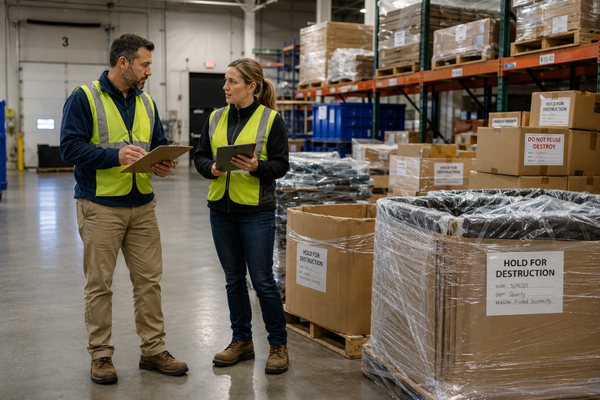
Off-spec material destruction programs need more structure than a disposal request or an extra pickup. In a warehouse, manufacturing plant, distribution center, or municipal facility, rejected material can move quickly when the process is unclear. A mislabeled pallet may be mistaken for usable inventory. Branded packaging may end up in the wrong recycling stream. Confidential material may sit unsecured while employees wait for direction.
A destruction program checklist gives facility managers and operations teams a working process. It defines what counts as off-spec, where the material goes, who is responsible for it, how pickup is documented, and what proof the facility keeps after destruction.
Why off-spec material destruction programs need a formal checklist
Off-spec waste handling often involves more than removing unusable material from the floor. A facility may need to manage rejected product, obsolete packaging, damaged goods, outdated labels, confidential records, recalled materials, or customer-specific inventory that cannot be resold, reused, or released.
Without a written process, those materials tend to move through informal channels. One department places them on hold. Another moves them to a staging area. A third assumes they are standard scrap. That handoff pattern creates risk because no one has a complete record of where the material went or who approved the next step.
For Massachusetts and New England facilities, destruction planning also needs to account for state recycling and disposal requirements. MassDEP waste disposal bans restrict certain recyclable, compostable, and hazardous materials from disposal or transfer for disposal, so facilities need to understand whether off-spec material belongs in a destruction, recycling, composting, or disposal pathway. MassDEP’s waste disposal ban guidance is a useful reference for Massachusetts facilities reviewing internal procedures.
1. Define what counts as off-spec material
The first step is to define “off-spec” in plain operational terms. Employees should not have to guess whether a pallet, carton, roll, bin, or container belongs in the destruction process.
Common examples include rejected production runs, damaged packaging, obsolete labels, misprinted cartons, expired inventory, returned goods, recalled items, prototypes, customer-specific materials, confidential paper, branded scrap, and materials that fail internal or customer quality standards.
The definition also needs to separate routine recyclables from materials that require secure destruction procedures. Clean, unbranded corrugated may be managed through a normal recycling program. Branded cartons, labeled packaging, confidential files, serialized products, or obsolete customer materials may require controlled handling and a certificate of destruction.
2. Segregate material at the source
Segregation works best where the issue is first identified. Waiting until material reaches a general recycling area or waste dock makes the process harder to control.
If a production team rejects a run, the material belongs in a designated hold area, gaylord, pallet location, cart, cage, or locked container. The same applies to warehouse returns, damaged goods, misprinted packaging, and obsolete branded materials.
Labels need to be direct. “Hold for Destruction,” “Rejected Product,” “Branded Packaging — Do Not Reuse,” and “Confidential Material” are more useful than internal shorthand that only one department understands.
Facilities with multiple material streams should avoid mixing different risk categories unless the destruction vendor has approved that process. Branded packaging, confidential paper, plastic film, corrugated cardboard, hard drives, obsolete labels, and defective product may each require different handling, destruction methods, or documentation.
3. Set up secure storage before pickup
Secure storage is where many off-spec material destruction programs break down. Material may be properly identified, then left in a dock area, open warehouse aisle, or shared staging zone until pickup. That creates room for accidental reuse, scavenging, contamination, or undocumented movement.
Storage requirements need to match the risk of the material. Low-risk recyclable scrap may only need a clearly marked staging area. Branded, confidential, proprietary, customer-owned, or regulated material may require locked containers, limited-access cages, supervisor-controlled release, or camera-monitored storage.
For sensitive documents, commercial confidential material disposal may require secure pickup-through-destruction handling, screened personnel, surveillance, and audited processes.
4. Assign employee accountability
A destruction program needs named responsibilities. “Warehouse will handle it” or “EHS will coordinate” is usually not specific enough.
The checklist identifies who can classify material as off-spec, who can move it to the destruction area, who approves release to the vendor, who signs pickup paperwork, who receives the certificate of destruction, and who files the record.
This is especially important in facilities with multiple shifts. A quality hold created on first shift should not become an unclear disposal issue on second or third shift. The process tells supervisors what to do when a container is full, when a pickup is missed, when material is mislabeled, or when an employee finds off-spec material outside the approved area.
Training should stay practical. Employees need to know what off-spec material looks like, where it goes, what cannot be placed in standard trash or recycling, and who to notify when there is a question.
5. Document pickup procedures
Documented pickup procedures create the handoff between the facility and the destruction vendor. This handoff should not rely on memory, emails, or verbal instructions at the dock.
The pickup procedure includes the pickup location, material description, estimated quantity, container count, required security conditions, internal contact, vendor contact, and paperwork requirements. The actual pickup record captures the service date, time, driver or technician name, container or pallet count, material description, and signatures from both parties.
Pickup records are not just administrative backup. They are the first external link in the chain of custody for material destruction.
6. Maintain chain of custody for material destruction
A chain of custody for material destruction is the record that shows who controlled the material from identification through final destruction. It accounts for each major handoff.
A strong chain of custody includes internal release authorization, vendor pickup confirmation, transportation records, receiving confirmation when applicable, destruction method, destruction date, and final documentation. For hard drives, serialized items, customer-owned materials, or high-risk product, item-level logs may also be required.
The chain of custody needs to be easy to follow after the fact. If a customer, auditor, corporate manager, or compliance lead asks what happened to a specific batch, pallet, container, or asset group, the facility should be able to trace the process without rebuilding it from scattered emails.
For secure information destruction, i-SIGMA’s NAID AAA Certification includes verification of secure handling, transportation, chain of custody, employee background screening, and scheduled and unannounced audits.
7. Require a certificate of destruction
A certificate of destruction is the facility’s final record that the material was destroyed through the agreed process. It should not be treated as optional for branded, confidential, customer-specific, regulated, or serialized material.
A useful certificate includes the customer name, service date, material description, quantity or weight, destruction method, service provider, destruction location or process reference, and an authorized signature or certification statement.
Some programs need supporting documentation, such as serial number logs, weight tickets, photos, manifests, service reports, or container tracking. The level of documentation should match the risk of the material and the requirements of the customer or internal program.
For complete peace of mind, we recommend working with a service provider who is NAID AAA certified. You will receive a certificate that confirms secure destruction of your confidential and sensitive materials.
8. Coordinate vendor requirements before material accumulates
Vendor coordination needs to happen before material starts filling containers. Waiting until a dock area is full can lead to rushed decisions, rejected loads, contamination issues, or missing documentation.
Before the first pickup, the facility needs to confirm what materials the vendor can accept, how each material must be packaged, whether contaminants must be removed, what containers are available, how pickups are scheduled, what documentation is issued, and whether destruction can be witnessed when required.
The facility also needs to confirm whether the material has recycling value after destruction. Some off-spec packaging, plastic, paper, metal, or electronics streams may still be recoverable if they are kept clean, sorted correctly, and handled through the right process.
Applied example: rejected branded packaging
A manufacturer rejects several pallets of branded cartons after a print error. The cartons are clean and recyclable, but they cannot enter the standard cardboard stream because the brand owner requires proof that the packaging will not be reused or released.
Under a clear destruction program checklist, quality labels the pallets as “Branded Packaging — Hold for Destruction.” Warehouse staff move them to a designated staging area. A supervisor records the pallet count, work order, and reason for destruction. The vendor confirms packaging requirements, picks up the material, documents the handoff, destroys the cartons, and issues a certificate of destruction.
The facility keeps the certificate with the quality hold record and customer documentation. The material is controlled, the brand risk is reduced, and the facility does not have to reconstruct the process later from emails or dock notes.
What should be included in an off-spec material destruction program?
An off-spec material destruction program includes material definitions, segregation rules, secure storage requirements, employee responsibilities, documented pickup procedures, chain of custody records, certificates of destruction, vendor contacts, and review intervals.
The program also identifies which materials require secure destruction procedures and which can move through standard or specialized recycling channels. That distinction helps prevent overhandling low-risk recyclables while still protecting sensitive, branded, proprietary, or customer-controlled materials.
Build a repeatable off-spec material destruction process
Off-spec material destruction programs work when the process is clear, documented, and repeatable. The goal is not extra paperwork. The goal is to prevent controlled material from being reused, resold, misplaced, or removed without a record.
A reliable program gives the facility control at each step: identification, segregation, secure storage, pickup, chain of custody, destruction, and documentation. It also gives managers a way to review performance and correct problems before they become customer, compliance, or operational issues.
For support with off-spec waste handling, chain of custody for material destruction, certificates of destruction, or vendor-managed pickups, contact us to discuss your facility’s material stream and service requirements.